The Kurrent alphabet
Each Kurrent letter sits on a faint line, with its modern form below.
Lower case
- aa
- bb
- cc
- dd
- ee2
- ff1
- gg
- hh4
- ii
- jj
- kk4
- ll
- mm
- nn2
- oo
- pp
- qq
- rr
- ss (long)1
- $s (round)1
- tt
- uu3
- vv
- ww
- xx
- yy
- zz
- ßß
Upper case
- AA5
- BB
- CC5
- DD
- EE5
- FF
- GG5
- HH
- II5
- JJ5
- KK
- LL5
- MM
- NN
- OO5
- PP
- QQ
- RR
- SS
- TT
- UU3
- VV
- WW
- XX
- YY
- ZZ
Letters written together
- àch
- Àsch
- áck
- ùst
- òss
- útz
- ää
- öö
- üü
The classic traps
- 1Long s and f. Long s, the normal s at the start of and inside a syllable, reaches below the line like f – but f has an extra loop or cross-stroke. Round s ends a word or syllable: Orts·bürger.
- 2e and n. The Kurrent e is two short strokes and looks like a narrow n. Count the strokes, then read the whole word rather than the single letter.
- 3u with a bow. The bow over u is no umlaut – it tells u apart from n. Umlauts (ä, ö, ü) carry two short strokes or a tiny e; the two dots on y belong to the letter.
- 4h and k. Both start with a loop above the line. The h also has a long loop below the line; the k stays on the line and has a small cross-stroke in its stem.
- 5Capitals that look alike. I and J are one form. C, E and L share their opening stroke – look at how they end. A, G and O start with the same bow; G reaches below the line.
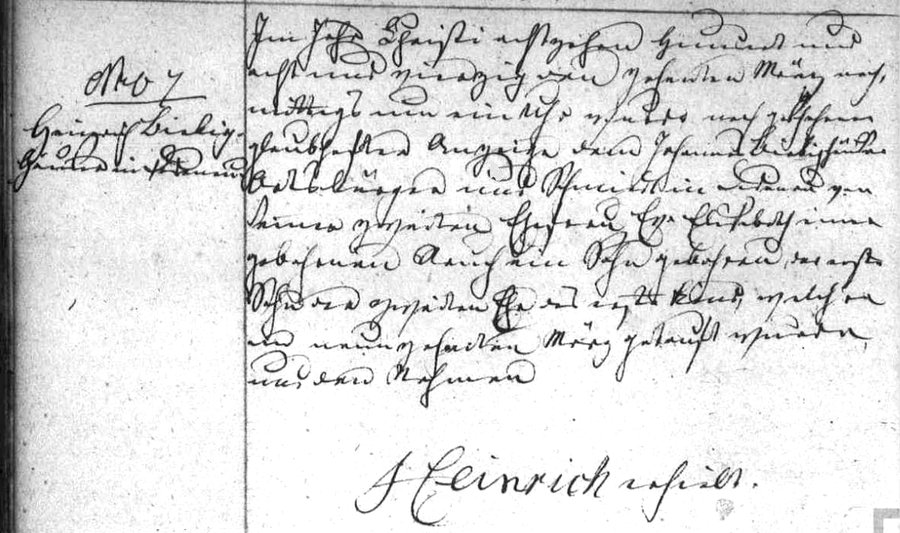
The letters shown are a clean copybook model of 1788. Real hands of the 1800s slant more, run letters together and simplify – so trust shapes in context more than single letters.
Words, months and numbers you will meet
Words in every baptism, marriage and burial entry
Words in every baptism, marriage and burial entry: Kurrent, German, English
| Kurrent | German | English |
|---|
| getauft | getauft | baptized |
| geboren | geboren | born |
| geborene | geborene, geb. | née (maiden name) |
| ehelià | ehelich | legitimate, born in wedlock |
| unehelià | unehelich | illegitimate |
| Sohn | Sohn | son |
| Toàter | Tochter | daughter |
| Pate | Pate, Gevatter | godparent, sponsor |
| todtgeboren | todtgeboren | stillborn |
| Ehefrau | Ehefrau | wife |
| copuliert | copuliert, getraut | married |
| Bräutigam | Bräutigam | groom |
| Braut | Braut | bride |
| ledig | ledig | single, unmarried |
| Junggesell | Junggesell | bachelor |
| Jungfrau | Jungfrau | maiden, unmarried woman |
| Witwer | Witwer / Witwe | widower / widow |
| geùorben | gestorben | died |
| begraben | begraben, beerdigt | buried |
| weiland | weiland | the late (deceased) |
| hinterlaòen | hinterlassen(e) | left behind, surviving |
| alt | alt … Jahre | aged … years |
| Ort$bürger | Ortsbürger | citizen of the village |
| Beisaòe | Beisasse | resident without full rights |
| Bauer | Bauer | farmer |
| Aáermann | Ackermann | farmer, husbandman |
| Taglöhner | Taglöhner | day laborer |
| Sàmied | Schmied | smith |
| Sàneider | Schneider | tailor |
| Leineweber | Leineweber | linen weaver |
weiland Jacob = the late Jacob. hinterlassener Sohn = a son whose father had died. Jungfrau simply means an unmarried young woman. Spellings vary: todt for tot, copulirt for copuliert.
Months
Months: English, Latin form and old German name
| Month | Latin form | Old German name |
|---|
| January | Januarii | Jänner |
| February | Februarii | Hornung |
| March | Martii | Lenz, Lenzmonat |
| April | Aprilis | Ostermonat |
| May | Maji | Maimonat, Wonnemonat |
| June | Junii | Brachmonat |
| July | Julii | Heumonat |
| August | Augusti | Erntemonat, Augstmonat |
| September | 7bris, 7ber | Herbstmonat |
| October | 8bris, 8ber | Weinmonat |
| November | 9bris, 9ber | Wintermonat |
| December | Xbris, Xber | Christmonat |
7bris is September, not July: the Roman year began in March, so septem (seven) became the ninth month. Old German month names varied by region – check them against the dates of the entries around them.
Numbers written as words
- 1
- eins, ein
- 2
- zwei, zwey
- 3
- drei, drey
- 4
- vier
- 5
- fünf
- 6
- sechs
- 7
- sieben
- 8
- acht
- 11
- elf, eilf
- 12
- zwölf
- 20
- zwanzig
- 30
- dreißig
- 40
- vierzig
- 70
- siebzig, siebenzig
- 100
- hundert
- 1000
- tausend
- Units come before tens: achtundvierzig = eight-and-forty = 48.
- achtzehnhundert und achtundvierzig = 1848.
- Days are ordinals: den zehnten März = 10 March, den einundzwanzigsten = the 21st.
Latin first names
Latin first names with their German and English forms
| Latin | German | English |
|---|
| Joannes | Johannes, Johann | John |
| Henricus | Heinrich | Henry |
| Jacobus | Jakob | Jacob, James |
| Georgius | Georg | George |
| Ludovicus | Ludwig | Louis, Lewis |
| Catharina | Katharina | Catherine |
| Elisabetha | Elisabeth | Elizabeth |
| Margaretha | Margarete | Margaret |
Latin names change their ending with the grammar: filius Joannis = son of Johannes, Henrici = Heinrich’s.